sHARA
Podcast
Listen and Download
The Silicon Dreams
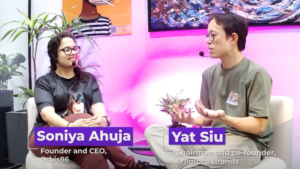
In this episode of The Silicon Dreams presented by Orbis86, Soniya Ahuja, interviews Hong Kong entrepreneur Yat Siu who co-founded Animoca Brands, a leader in blockchain gaming like The Sandbox, pushing for digital property rights in the metaverse.
Soniya: Hello, everyone. Welcome to another episode of Silicon Dreams with Yat. Yat needs no introduction. He is the mastermind behind Animoca Brands and has led many gaming startups to success, especially in the Web3 world. As you know, Animoca Brands has an amazing portfolio, including the Sandbox, one of the most famous games originally created by Pixel, which took the metaverse by storm. Yat, it’s a pleasure to have you here on our show today.
Yat: Thank you for having me. It’s a real pleasure to be here.
Soniya: And thank you for finding the time to chat with us. So without further ado, I would love to ask about your experience at Token 2049. Dubai is an amazing hub for Web3 entrepreneurs, investors, and gamers. Could you summarize some of the key updates coming from Animoca Brands?
Yat: Sure. First of all, the energy at Token 2049 was incredible. There’s a bit of a joke that Dubai is awash in liquidity, but the energy is truly electric. People are really excited. We’re currently at our portfolio day, and everyone is enthusiastic and networking. At Animoca, we’ve made over 450 investments, with more than 150 in games. You mentioned the Sandbox, but we also have Pixels and, of course, Axie Infinity by Sky Mavis, among other game studios that are really shaking up the market and showcasing what’s possible in Web3. It’s been very exciting to see.
Soniya: Absolutely. Folks, if you haven’t checked out these games, you should. Sky Mavis, for instance, has recently taken the App Store by storm. As someone building a gaming platform on Web3, I’m very invested in seeing where the major wins are coming from. I have a quick question for you: When do you think Web3 will have its Minesweeper, Roblox, or Fortnite moment? And I’m guessing it’s going to come from Animoca. I’d love to hear your thoughts.
Yat: One of the key principles we believe in at Animoca is the concept of a shared network. We invest broadly in the Web3 space because we believe that if one company does really well, it will lift the entire ecosystem. When you build on-chain, the network effects are shared, unlike in Web2 where a game’s success is isolated. So even if we don’t end up investing in the biggest game, we’ll still benefit as the ecosystem grows. This is a core part of our investment thesis and growth strategy.
Yat: Another important point is that to become a Web3 gamer, you need some financial literacy. Web3 users have more of an investing mindset. They view it through the lens of investment, while traditional gamers see gaming purely as entertainment.
Soniya: Fun, entertainment.
Yat: And by the way, I also believe that people generally have an investing mindset. They’re just not applying it to the games they play because they think of them as fun entertainment. But at the end of the day, they actually are investing. When you’re spending hours in a game, you’re investing your feelings, your time, your emotions, your connections, and your social status. You might start off thinking it’s fun, but you end up making a deep investment, if not in money, then in time. In Web3, you recognize that when you invest in a game, be it time or money, you’re making an investment. Everything in life, even entertainment, is an investment. When we do sports, it’s not just for physical benefits; it’s an investment in our health. Relationships are perhaps our biggest investment. We’re attuned to invest in one form or another. Web3 elucidates that. The challenge is getting people from Web2 gaming to Web3, to understand that life is a personal investment in time and value, making Web3 gaming more rewarding.
Yat: The Web3 users have personified and created these values. Web2 users need financial literacy. It’s not about easier wallets or abstracting too much; it’s about understanding the value.
Soniya: Yes, absolutely. There are prejudices because the crypto industry is volatile, and people associate Web3 gaming with that volatility.
Yat: But I go back to the principle of financial literacy. If you’re financially literate, you understand we exist in a capitalist framework. Capitalism is volatile and a proxy for change. It tells you about the state of your business, whether good or bad. In today’s world, you might think it’s stable due to employment indexes or fixed inflation rates, but it’s anything but stable. Web3 makes this volatility visible daily.
Soniya: Nothing is as transparent as Web3. If you know where to find the information, it’s all there. In the traditional Web2 world, you have to go through hoops to access that information. Monetization in gaming wasn’t created by Web3. Platforms like Twitch provided a way for gamers to stream and make money.
Yat: Correct. But platforms like Twitch or Twitter have limited network effects. You can make money, but not as much as in Web3 because network effects are shared and bridge across. Tokens represent these network effects, embedding both utility and financial networks. This is a new concept unique to tokens. In the physical world, social networks and financial systems don’t talk to each other. Blockchain merges these, amplifying social relations by combining network effects. Designing tokens with this understanding leads to more success.
Soniya: Absolutely. One of the core tenets of Web3 is the sense of community, belonging, and growing together.
Yat: Community and belonging are network effects.
Soniya: That is a network effect. Well, finally, what are some of the major headlines we should look forward to this year, especially coming out of Token 2049?
Yat: You’ll see more Bitcoin spot ETFs coming out. Hong Kong recently announced a conditional approval for Bitcoin and Ethereum spot ETFs. Other places like London, Singapore, and Tokyo may follow. This will bring more capital into the market and grow the ecosystem. We also announced our financials recently, showing $290 million in cash and about $2.4 billion in on-and-off-balance sheet tokens. This shows that businesses in Web3 are doing well. It’s an opportunity for Web2 companies to consider Web3 for growth. In Web3, it reminds me of the early days of mobile gaming. There’s a huge opportunity for gaming studios. If you’re interested in making Web3 products, talk to Animoca Brands. We might have a check for you.
Soniya: Absolutely. Animoca has led investments in some of the best Web3 gaming companies. How do you see AI influencing the growth of Web3 gaming?
Yat: AI will supercharge Web3 in amazing ways. Digital provenance through blockchain will allow AI to share value. Autonomous agents will transact using crypto, as they can’t use fiat or have bank accounts. This will increase the velocity of liquidity in the Web3 space.
Soniya: Thank you, Yat. One final question: How can people get in touch with Animoca if they’re building something and seeking investment?
Yat: We have multiple pools of capital. You can contact Animoca Ventures through our website or approach our teams at events like this one in Dubai. We’re present at almost every event, so don’t be shy. Hustle is important. If someone doesn’t answer you, keep trying. Perseverance is key for any entrepreneur. Believe in yourself and your product and keep going.
Soniya: Thank you, Yat. That was an amazing message for all the entrepreneurs and hustlers out there. Be perseverant, and your perseverance will pay off. Thanks again for joining us today.
Yat: My pleasure. Thank you for having me. I appreciate it.